· By LineCue
How do you rehearse a scene with no reader?
The hard part of rehearsing alone is not remembering the lines. It is learning to come in on a cue you set yourself.
Record the other character's lines as three cue tracks, leaving a generous, natural, then tight amount of room for your responses. The difficulty of rehearsing alone is rarely recall. It is that you control the pace, so you can learn a rhythm no scene partner will give you.
You get the sides on a Tuesday night. The audition is Thursday. Nobody is free to read with you, so you do what everyone does: you run it alone, out loud, again and again, until the words arrive without effort.
Then you get in the room, and you are half a beat off.
Not wrong, and not unprepared. Just off. You come in a fraction early, or you hang a fraction too long, and the scene never quite catches. Most actors file that under nerves.
It usually is not nerves. It is that you rehearsed a pace that does not exist.
Why rehearsing alone stops working
Almost every guide to rehearsing without a reader is about the words. Paraphrase the text until you know what you are saying. Write the lines out by hand. Get up and move while you run it. Record the other character's lines and play them back.
All of that is sound advice, and none of it addresses the thing that actually breaks.
When you rehearse alone, you are the only variable in the room. You decide how much space exists between turns, because the other character is a recording you made, a voice in your head, or a pause you are silently counting through. Every run teaches your body the same rhythm. Twenty runs teach it very well.
Then a real actor reads opposite you, pauses or responds differently, and the rhythm you spent two days drilling becomes the thing working against you.
Two words worth pinning down, because they get used loosely. Your cue is whatever tells you it is your turn, usually the end of the other character's line. Off book means you can play the scene without the page in your hand. You can be completely off book and still miss every cue in the scene.
What a reader actually gives you
It helps to be precise about what you are missing, because it is not company and it is not encouragement. A reader gives you three things:
- A pace you do not control. They are fast when they are fast. You adjust, live.
- A cue you have to listen for. You cannot predict the exact moment their line ends, so you have to actually hear it.
- An interruption you cannot plan. Sometimes they come in early, or step on your last word, and the scene has to survive it.
A recorded cue track helps, but it repeats the same pattern every time. The drill below cannot make a recording genuinely unpredictable; it can stop one rhythm becoming the only rhythm you know.
The three-pass tempo drill
The fix is not more repetition. It is varied repetition, with the variation in one specific place: the amount of room the cue track leaves for your response before the next recorded line begins.
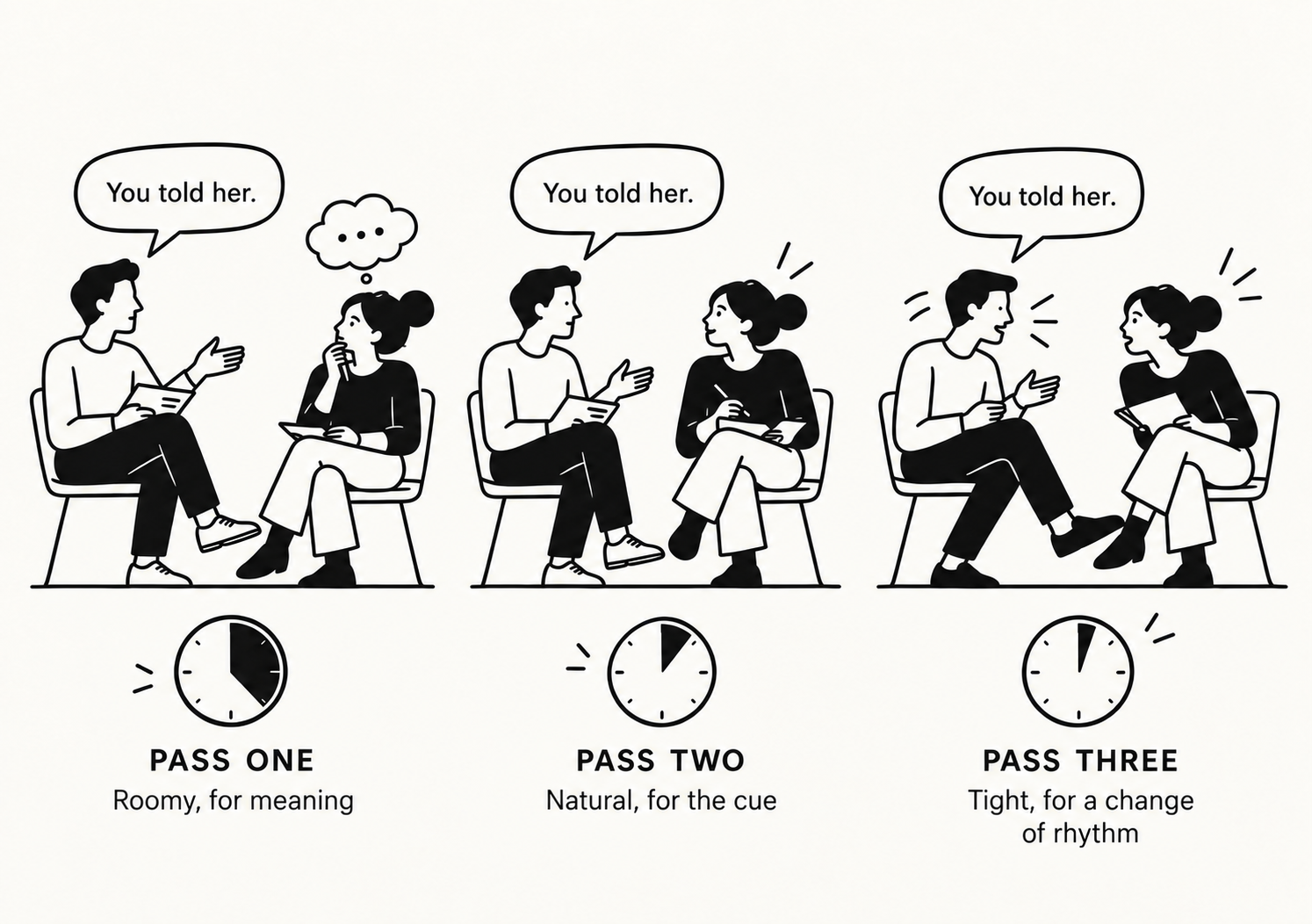
Make three versions of the other character's cue track, then run the scene once with each. Do not deliberately change your own performance. Change only the silence between their recorded lines. That silence is where your response has to fit.
Here is a short fictional exchange, so the passes are concrete:
DEV: You told her.
NAOMI: I told her what she already knew.
DEV: That is not the same thing and you know it.
NAOMI: Then why did she thank me?
You are playing Naomi. Your cues are "You told her" and "and you know it".
Pass one: roomy, for meaning
Leave generous room between Dev's recorded lines. Take the time you need over Naomi's responses.
You are allowed to be bad at this pass. Its only job is to find out what you are actually saying and what you want from the other person. If you discover halfway through that you have been playing the second line as an apology when it is a defence, this is the pass that was supposed to catch it.
Pass two: natural, for the cue
Leave only as much room as the exchange needs at a conversational pace.
This is the pass most people think they are doing when they run lines, and most are not, because the gaps they have been leaving themselves are generous. Listen for the end of Dev's line, answer without adding a comfortable pause, and let Naomi's response take the space it needs.
Pass three: tight, for the interruption
Leave very little room before Dev's next recorded line begins. It should be tight enough to crowd, or occasionally overlap, the end of Naomi's response.
This pass feels horrible, which is why it is worth doing, and why almost nobody does it. It breaks the habit of expecting the scene to preserve the space you practised. Do not race simply to beat the recording. Keep the intention clear and recover when the rhythm changes.
For each cue track, record all of the other character's lines and leave silence where your lines belong. Make that silence generous in the first version, natural in the second and tight in the third. It is about ten minutes of setup and it is the difference between rehearsing a scene and rehearsing one fixed recording.
How to tell you have learned a false pace
A few signs, all of them common and none of them a disaster:
- You need the whole of the other character's line to come in, not just the end of it.
- Your first word lands at the same volume and pitch every single time.
- A pause feels wrong rather than long.
- You cannot do the scene to any rhythm other than the one you practised.
A quick test for the last one: run the scene once at roughly double speed, gabbling, no performance at all. If it holds together, you know the scene. If it collapses, you have learned a recording.
Running the drill in LineCue
This is the part about our app, and it is deliberately short, because everything above works with a phone and no app at all.
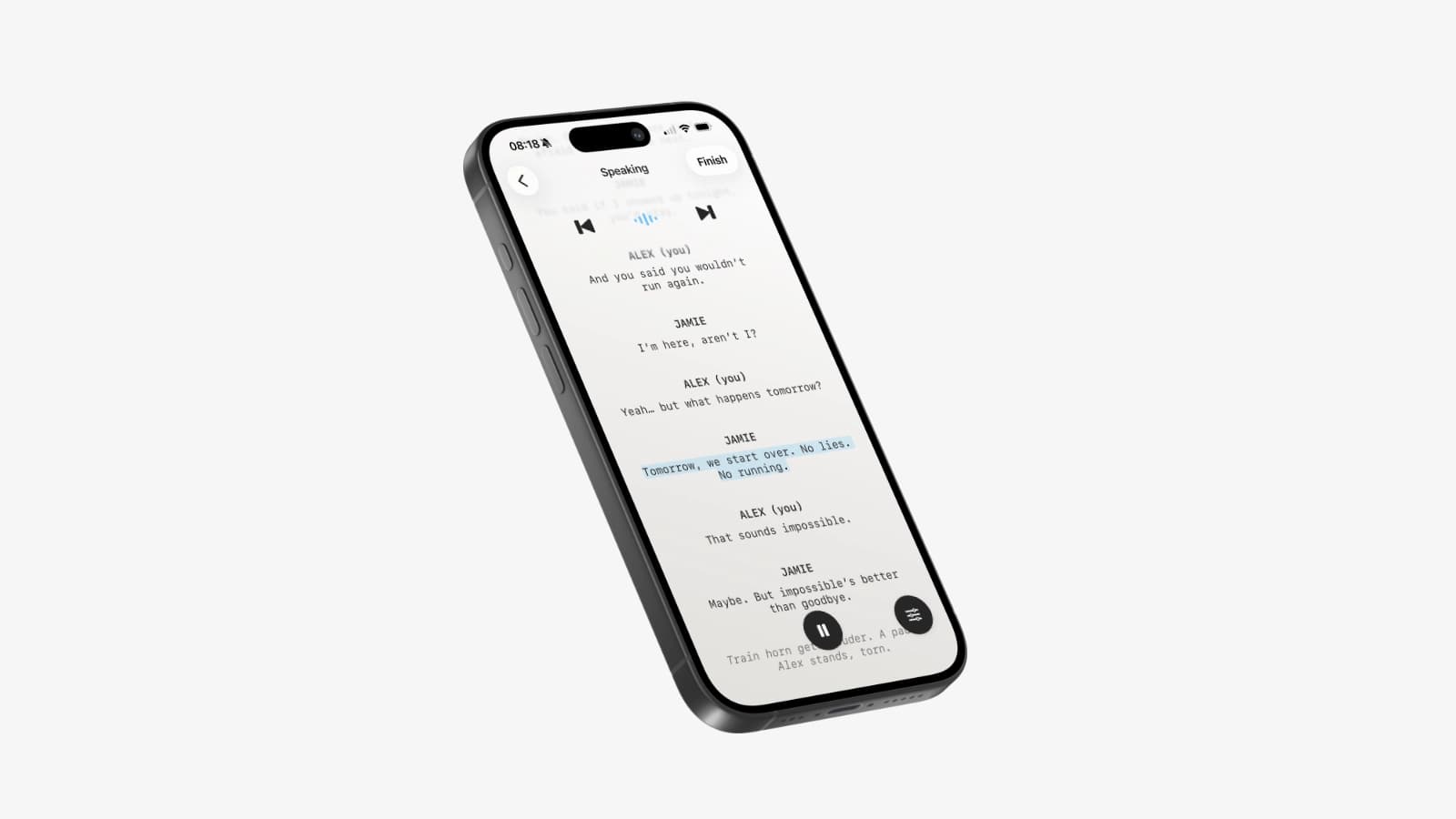
In Rehearse mode you read your character's lines aloud and LineCue reads every other part. Cue delay lets you apply the same roomy-to-tight progression to the turnaround after your lines:
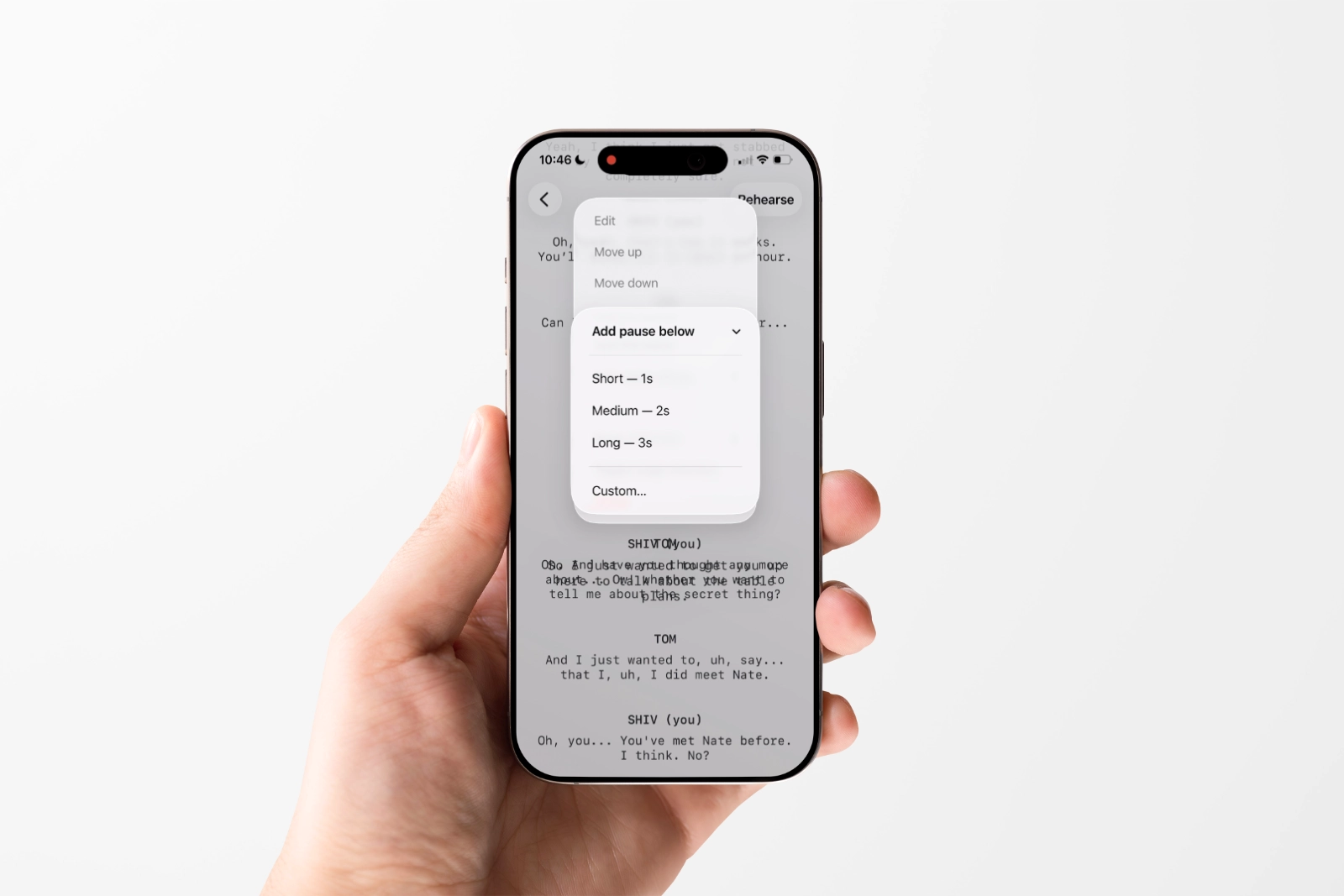
- Cue delay is adjustable: it changes how soon the other character comes back at you once you have finished. Start with a longer pause, make it conversational on the next run, then tighten it. Same script, nothing re-recorded.
- Auto-Cue listens while you speak and advances the script by itself, so the scene moves when you move rather than on a timer, and your hands stay free. Manual next and previous are always available.
- Loop restarts the scene when it finishes, and Countdown gives you a few seconds to get set before playback starts. Together they make repeated cold runs possible without touching the screen.
If you want the settings rather than the technique, they are documented properly in the Support Center: Rehearsing, Auto-Cue and Looping and countdowns.
What to check before you call the scene rehearsed
Not a checklist for the performance. A checklist for the preparation:
- Can you come in on the end of the cue, rather than needing the whole line?
- Have you run it at least once faster than is comfortable?
- Do you know what you want from the other character in each of your lines, or only what you say?
- Can you survive being interrupted?
- Would the scene still work if the other actor made a completely different choice than your recording did?
If the answer to the last one is no, you have not rehearsed a scene yet. You have rehearsed your half of one, which is the specific trap of working alone, and it is entirely fixable in three passes.